







Published Mon 30th Mar 2026
Wireless remote condition monitoring has been used on railways since at least 2010, with applications including structures, earthworks and track - which is the topic of this article. The team at Senceive pioneered many of these applications and provides solutions for rail engineers and infrastructure owners around the world. Senceive is part of the Eddyfi Technologies Remote Monitoring product line, an international group designing, manufacturing and supporting instrumentation and monitoring solutions.
The Need for Rail Track Monitoring
Changes in track geometry can arise for many reasons, including increased loading, temperature variations, deterioration of ballast or underlying ground, or outside forces such as adjacent construction activity.
The impact can be far-reaching: gradual track deterioration affects passenger ride comfort and damages rolling stock; speed reductions and temporary repairs cause expensive delays; and in extreme cases poor track can cause dangerous and highly disruptive derailments.
Why Wireless?
There is a growing range of technologies that measure changes in track geometry and anyone responsible for making the right choice should consider factors such as: level of absolute accuracy required, availability of track access, duration of monitoring programme and frequency of readings needed to detect the parameter/s of interest.
At the low cost/high volume end of the spectrum, vehicle mounted scanning systems offer the most economical coverage for large sites but this comes at the expense of absolute accuracy and the frequency of readings At the other end of the spectrum, repeated geodetic surveys of track-mounted prisms using a total station deliver extremely high accuracy, but they require either frequent site visits by a surveyor or an investment in a costly automated total station (ATMS). . The wireless solution sits somewhere in between these options and brings certain advantages such as no need for line of sight, unrivalled frequency of readings and low ongoing cost after installation.
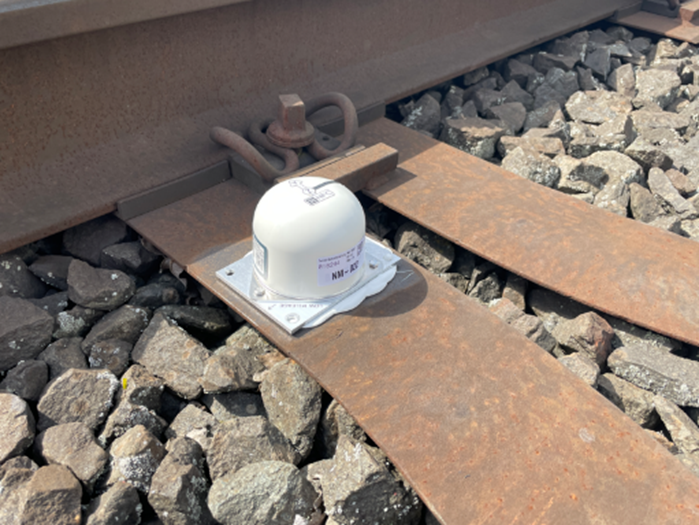
Undertrack crossing Ulzburg – Lübeck Germany: tilt nodes and laser displacement sensors used to assess track movement during construction of an undertrack culvert for new electricity cables. The monitoring programme allowed train movements to continue safely and without disruption and accelerated the culvert construction because it was immediately apparent that it was not causing a significant degree of track deformation.
How Does it Work?
A typical wireless track monitoring system comprises three key elements: triaxial tilt sensors, a cellular communications Gateway, and an online data portal. Tilt sensors detect angular movement to a high degree of precision (0.0001°) and repeatability (±0.0005°). When fixed to a track sleeper several significant track movement parameters can be measured, and others derived through calculation. Wireless systems can integrate many other types of instruments and sensors, including laser displacement sensors to measure relative movement between two surfaces, and geotechnical instruments such as borehole inclinometers and extensometers to characterise ground movement.
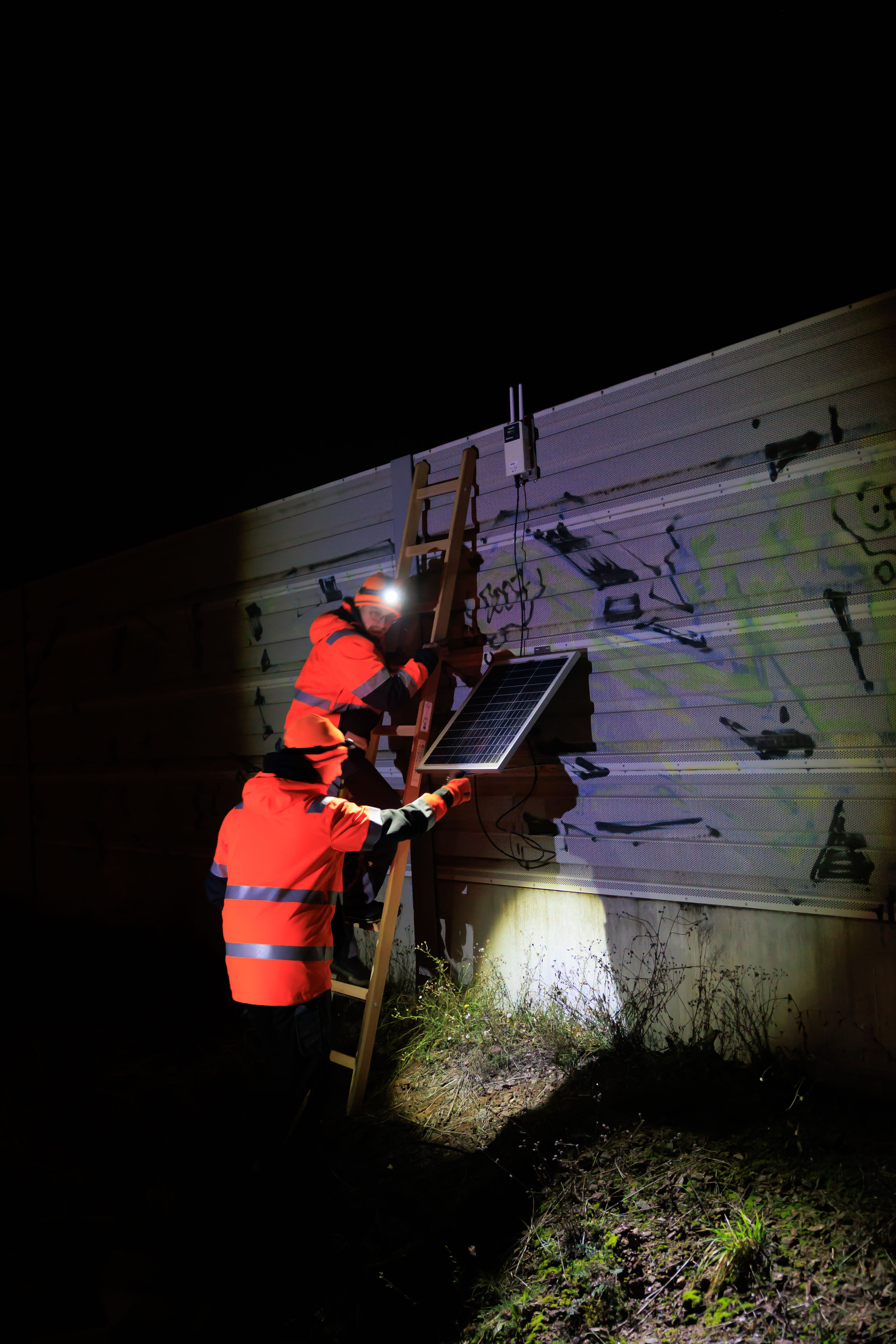
Data transmission from the Gateway to the online data portal typically uses the cellular network but can also use ethernet, Wi-Fi, or even satellite communications, depending on site conditions. The use of cellular comms, together with solar powered gateways, makes this a truly remote monitoring solution because it needs no fixed power or communications infrastructure.
Data upload is usually on a scheduled (e.g. 30 minute) cycle, but responsive systems such as Senceive’s FlatMesh sensors can wake up instantly if triggered by movement – thus delivering a solution that effectively provides near real-time 24/7 coverage. Crucially, the system sends alerts via SMS or email to any number of stakeholder if a significant event is detected.
Deliverables from Wireless Monitoring
The most recognised track geometry deliverables from a wireless monitoring solution are cant/cross-level, rail twist and relative settlement. Ongoing developments are constantly adding new possibilities, including buckle and vertical movement due to ballast voiding.
The main deliverables are summarised below.
Cross-level / cant: tilt sensors measure the angular movement of the sleeper, which is used to compute changes in the cross-level of the rails. If absolute cross-level values are required, then a track survey must be carried out, to which the relative change measured by the tilt sensors can be applied. If no survey is carried out, the sensors can simply be zeroed, with the reported value being the relative rather than absolute change.
Rail twist: this is the difference in cross-level across a given distance along the track. Large twist faults over short distances can lead to wheel unloading and derailment as one wheel becomes unsupported by the track if the suspension cannot compensate. In the UK, twist is normally measured over 3m spacing due to the 10-foot wheelbase of older four-wheeled single-axle wagons. Similar spacing is required in Germany. In the U.S., twist is measured as the difference in cross-level between any two points less than 62 feet (18.9 m) apart according to FRA regulations.
Track profile: vertical alignment (referred to as profile in North America) is the measure of uniformity along the top of rail along a pre-determined distance. Upwards movement can be the result of frost heave, causing a localised hump. Dips can be caused by mud spots or the transfer from a bridge structure to normal track. Effective monitoring of such events using tilt sensors can be achieved by establishing a line of tilt nodes that extends outside the zone of movement and measuring the accumulated angular movement of every sleeper in the line. An exciting recent development is the ability to mount highly robust tilt sensors directly on the rail web, which enables direct measurement of rail movement and removes any doubts about the relationship between sleeper and rail movement.
Track slew / buckle: horizontal track movement can be a highly disruptive problem, most often encountered in spells of hot summer weather. Senceive track monitoring experts have addressed this issue using wireless temperature sensors that tell operators about actual rail temperature rather than more general air temperature. They also supply optical displacement sensors for use in areas of concern, such as high-speed curves to measure lateral movement of the rails.
Ballast voiding: can be monitored using the Sisgeo FLX-Rail system which is installed between the track and the ballast using powerful magnets allowing easy installation. It measures vertical deformation during the passage of every train.

The HS2 project has used wireless monitoring extensively, such as on the tracks approaching central Birmingham where the construction work is in close proximity to the existing railway.
Advantages – quick, simple, low maintenance
Wireless monitoring may not bring the absolute accuracy of a manual topographic survey, but it does bring a raft of advantages over most of the more well-established methods.
-
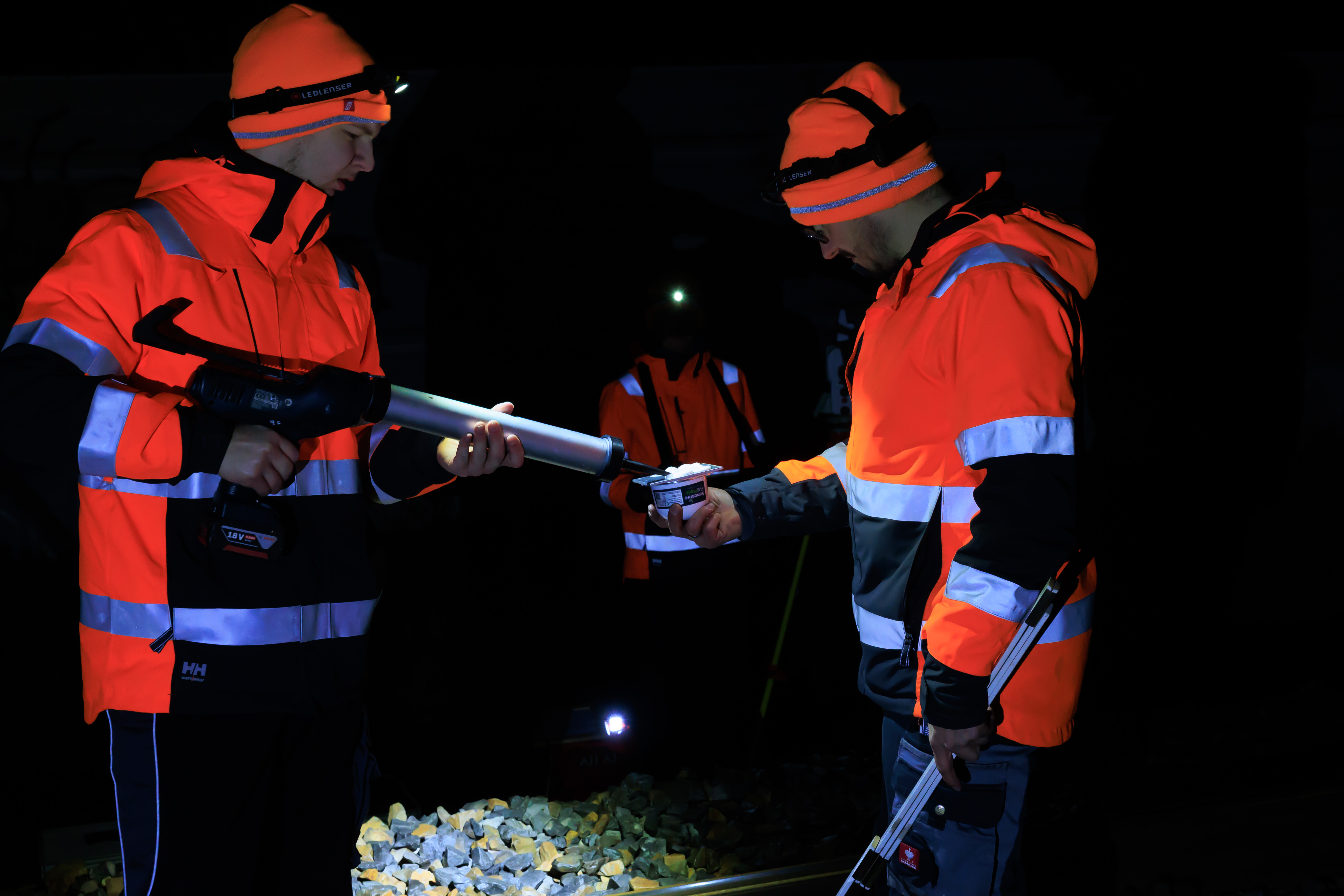
Quick installation – tilt sensors can be glued to sleepers in minutes and provide data within hours.
-
A truly remote, autonomous and automated approach – solar power and cellular comms mean no need for fixed power supply or wired internet link.
-
Forget the need for clear line of sight, tilt nodes will operate under snow, around curves and where line of sight is blocked by machinery or vegetation.
-
Responsive, constant vigilance – sampling can be as fast as sub-minute where needed e.g. over an undertrack crossing installation or a length of flood-damaged track.