







Optical Displacement Sensor Node

Optical Displacement Sensor Node
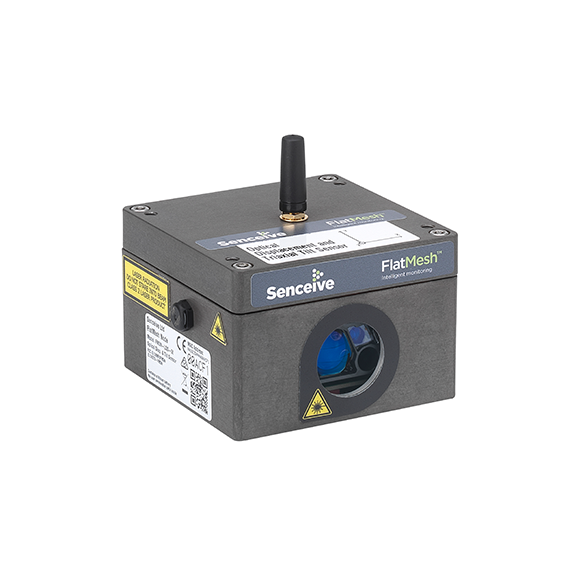
The Optical Displacement Sensor Node is an instrument which uses optical means to take high precision displacement measurements. These outputs are then passed through Senceive’s wireless communications network to a Gateway. It can also be combined with Senceive’s world-leading triaxial tilt sensor to obtain high precision tilt measurements that are linked to an external reference.
The distance measurement provides information about the deformation of a targeted structure and the tilt measurement informs the user on the stability of the sensor itself and of the reference structure where it is mounted.
Optical Displacement sensing is ideal for many structural and geotechnical monitoring applications, including those measuring:
- Convergence/divergence for tunnel/arch intrados or bridge abutments
- Vertical movements for structural settlement/heave
- Lateral movements such as rail track slew
- Earthworks and embankment movement
- Water level monitoring/dewatering







Features
Specifications
FAQs
What is an Optical Displacement Sensor Node?
The Senceive Optical Displacement Sensor Node (ODS) is a wireless instrument that uses optical technology to measure high-precision changes in distance to a target.
The ODS can be supplied as a standalone optical displacement sensor or with an optional integrated triaxial tilt sensor for applications where both displacement and tilt measurements are required. The optical sensor measures changes in distance to the target, while the optional triaxial tilt sensor measures changes in the orientation of the ODS itself.
Designed for continuous, remote monitoring, the ODS provides high-precision displacement measurements without the need for wired connections or frequent site visits.
What does an Optical Displacement Sensor measure?
The Optical Displacement Sensor measures changes in distance between the sensor and a target surface.
Changes in this distance can indicate movement or deformation of the monitored structure. Depending on the installation, the ODS can be used to measure:
-
Tunnel convergence and divergence
-
Structural settlement and heave
-
Bridge and structural movement
-
Rail track slew (buckle) and lateral movement
-
Earthworks and embankment movement
-
Water level changes and dewatering
-
Movement of temporary works and other structures
The sensor can be configured to monitor different movement directions depending on the position of the sensor and target.
How does the Optical Displacement Sensor Node work?
The ODS uses a visible red laser to measure the distance between the sensor and a target surface. Changes in this distance can indicate movement or deformation of the monitored structure.
The ODS can also be supplied with an optional integrated triaxial tilt sensor, providing tilt measurements alongside optical displacement data.
Both configurations communicate wirelessly through a Senceive monitoring network, allowing data to be collected remotely and visualised through WebMonitor™.
What makes the Optical Displacement Sensor different from other displacement sensors?
The ODS combines high-precision optical displacement measurement with wireless communications in a compact, robust sensor node.
An optional integrated triaxial tilt sensor can also be included where additional information about the orientation and movement of the sensor is required.
Key features include:
-
Optical resolution of 0.1 mm
-
Repeatability of ±0.15 mm
-
Optional triaxial tilt sensing with 0.0001° resolution
-
Long battery life for continuous monitoring
-
Integrated temperature measurement
-
Wireless communication through FlatMesh™ or GeoWAN™
-
Magnet-triggered aiming mode for easier alignment
-
Robust, weather-resistant enclosure
-
Versatile mounting options
This makes the ODS suitable for a wide range of structural and geotechnical monitoring applications.
What applications is the Optical Displacement Sensor best suited for?
The ODS is particularly suited to applications where precise, continuous measurement of relative movement is required.
Typical applications include:
-
Tunnel monitoring – measuring convergence and divergence of tunnel walls or intrados
-
Bridge monitoring – measuring movement of bridge abutments and structural elements
-
Rail track monitoring – measuring lateral track movement or slew (buckle)
-
Building and structural monitoring – detecting settlement, heave and deformation
-
Earthworks and embankments – monitoring movement of slopes and structures
-
Temporary works – monitoring movement of props and other temporary structures
-
Water level monitoring – measuring changes in water level during dewatering or other works
The optional integrated tilt sensor can provide additional information for applications where the movement or stability of the sensor mounting structure also needs to be monitored.
What is the measurement range of the Optical Displacement Sensor?
The measurement range depends on the target surface:
-
0.05–50 m for natural surfaces
-
0.05–100 m for white targets
-
40–150 m for reflecting targets
The optical sensor has a resolution of 0.1 mm and repeatability of ±0.15 mm. Actual performance depends on the target and environmental conditions.
What are the accuracy and resolution of the Optical Displacement Sensor?
The optical sensor has a resolution of 0.1 mm and repeatability of ±0.15 mm.
Where the ODS is supplied with the optional integrated triaxial tilt sensor, the tilt measurement has a resolution of 0.0001° (0.00175 mm/m) and repeatability of ±0.0005° (±0.0087 mm/m).
Why would I choose the Optical Displacement Sensor with an integrated tilt sensor?
The optional integrated triaxial tilt sensor provides an additional measurement alongside optical displacement, helping users understand movement at the sensor location.
This can be particularly useful where the stability or movement of the structure supporting the ODS is also important to the monitoring application.
The optional tilt sensor provides:
-
0.0001° (0.00175 mm/m) resolution
-
Triaxial measurement
-
Continuous tilt monitoring alongside displacement
-
Additional data to help interpret structural movement
For applications where tilt data is not required, the ODS can be used as a standalone optical displacement sensor.
Can the Optical Displacement Sensor measure tunnel convergence?
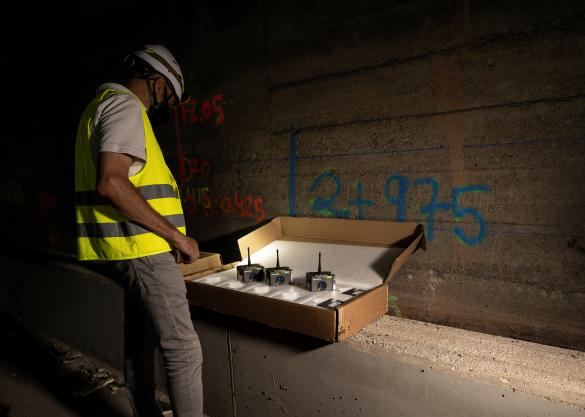
Yes. ODS nodes are well suited to monitoring tunnel convergence and divergence. Multiple sensors can be installed around the tunnel profile to measure changes in distance between opposing points. This allows changes in the tunnel's geometry to be monitored continuously.
The ODS can provide precise displacement data without the need for wired connections, making it suitable for long-term monitoring in tunnels and other difficult-to-access environments.
Can the Optical Displacement Sensor be used for rail monitoring?
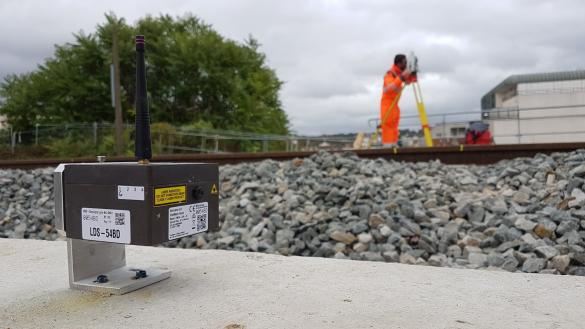
Yes. The ODS can be used to measure lateral movement such as rail track slew (buckle). It can also be used alongside other sensors to provide a broader picture of changes in track geometry and asset behaviour. Where required, the optional integrated triaxial tilt sensor can provide additional information about movement at the sensor location.
What mounting options are available for the Optical Displacement Sensor?
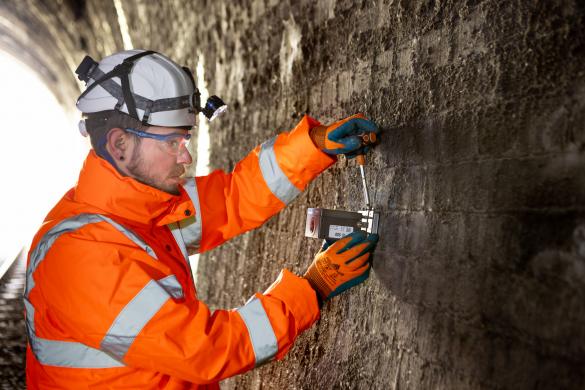
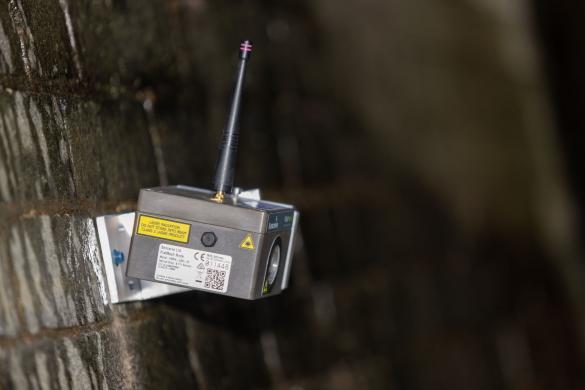
The ODS has versatile mounting options to suit different structures and applications.
Available mounting solutions include:
-
Magnetic mounting
-
Screw-fixed mounting
-
Trackbed mounting
-
Stake and pole mounting
-
Adjustable mounting plates and brackets
-
Solutions for vertical and inclined surfaces
A range of mounting accessories is available to help position and align the sensor with its target.
How easy is it to align the Optical Displacement Sensor with its target?
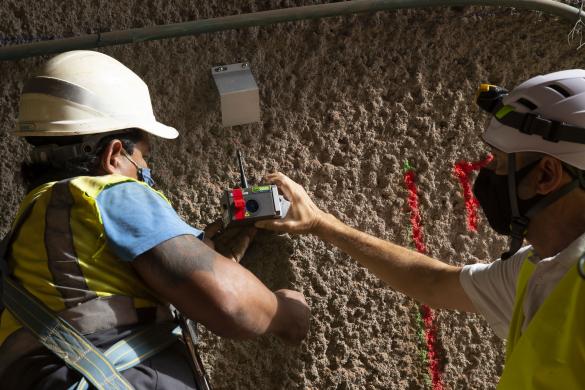
The ODS includes a magnet-triggered aiming mode to make alignment with the target easier during installation. This helps installers accurately position the optical sensor, making deployment and commissioning quicker and more straightforward.
How robust is the Optical Displacement Sensor?
The ODS is designed for demanding monitoring environments and is waterproof to IP66/IP67/IP68. The sensor features a robust die-cast aluminium housing and weather-resistant protection suitable for outdoor and underground applications. The operating temperature range for full functionality is -10°C to +50°C.
What is the battery life of the Optical Displacement Sensor?
The ODS has an integrated long-life battery designed for long-term monitoring without regular site visits.
Typical battery life is up to 10 years, depending on the communications configuration, reporting interval, target characteristics and environmental conditions.
Does the Optical Displacement Sensor measure temperature?
Yes. The ODS includes an integrated temperature sensor, providing additional temperature readings alongside displacement measurements.
Where the optional triaxial tilt sensor is included, tilt data is also available from the same sensor node.
Temperature data can help users understand environmental influences on monitored structures and support analysis of movement trends.
Is the Optical Displacement Sensor wireless?
Yes. The ODS is a wireless sensor node that transmits measurement data through Senceive's wireless communications platforms.
It is available for FlatMesh™ and GeoWAN™ networks, allowing the appropriate communications architecture to be selected for the monitoring application.
FlatMesh uses a mesh network architecture, while GeoWAN provides long-range wireless communications for applications where sensors may be distributed over large areas.
How do I visualise or access Optical Displacement Sensor data?
Data from the ODS is transmitted wirelessly to a Gateway and can then be visualised through WebMonitor™ or other third party data visualisation platforms.
Users can analyse trends and configure alerts according to the requirements of the monitoring project.
Can Optical Displacement Sensors be used with other Senceive sensors?
Yes. ODS sensor nodes can be combined with other sensors within the same monitoring system.
For example, Optical Displacement Sensors can be used alongside:
-
Triaxial tilt sensors
-
Temperature sensors
-
Crack sensors
-
Piezometers
-
In-place inclinometers
-
Strain gauges
-
Other third party geotechnical and structural instruments
This allows multiple parameters to be monitored through a single wireless monitoring system, providing a more complete picture of asset behaviour.
What are the specifications of the Optical Displacement Sensor Node?
|
Parameter |
Value |
|
Optical resolution |
0.1 mm |
|
Optical repeatability |
±0.15 mm |
|
Measurement range (natural surface) |
0.05–50 m |
|
Measurement range (white target) |
0.05–100 m |
|
Measurement range (reflecting target) |
40–150 m |
|
Laser |
Class 2, 655 nm visible red |
|
Optional triaxial tilt sensor resolution |
0.0001° (0.00175 mm/m) |
|
Optional triaxial tilt sensor repeatability |
±0.0005° (±0.0087 mm/m) |
|
Optional triaxial tilt sensor range |
±90° |
|
Integrated temperature sensor |
Yes |
|
Dimensions |
90 × 90 × 60 mm |
|
Mass |
Approx. 0.6 kg |
|
Housing |
Die-cast aluminium |
|
Protection |
IP66/IP67; IP68 at 1 m for 24 hours |
|
Battery |
Lithium Thionyl Chloride |
|
Typical battery life |
Up to 10 years* |
*Battery life depends on reporting interval, target characteristics and environmental conditions.
Get in touch
For more information on our Optical Displacement Sensor Node, call +44 (0)800 033 7731 or email info@senceive.com