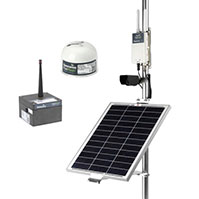
InfraGuard™
InfraGuard™ is a sophisticated wireless monitoring solution to help asset owners manage critical infrastructure.
It not only tells you what your assets are doing - it shows you. Smart tilt sensors respond to movement to give you immediate insight of an event at a remote site. You will get alerts of small-scale movement which could indicate the early signs of a slope or structural failure, and graded alerts of further movement, backed-up by photographic images. With a proven track record of detecting potentially disruptive and dangerous events, InfraGuard can be your eyes on site, without needing feet on the ground.
The system is suitable for many monitoring applications including:
Features
Specifications
FAQs
What is InfraGuard™?
InfraGuard is a sophisticated wireless monitoring solution from Senceive that provides near real-time alerts for movement and potential hazards at critical infrastructure and geotechnical sites. Built around the FlatMesh™ intelligent communications platform, this proven IoT solution combines high-precision tilt sensors, optional cameras, and smart network intelligence to deliver autonomous monitoring of remote sites exposed to geotechnical or structural risk.
A typical Senceive Infraguard installation applied to an earth slope will comprise:
- Multiple tilt sensors, such as Senceive NanoMacro tilt nodes, with a typical spacing of 2 metres in landside monitoring applications
- A wireless camera such as the Senceive FlatmMesh camera which sends photos of the site on a scheduled basis or when triggered by an alert generated by movement of the tilt sensors.
- An Edgehub cellular gateway which collates sensor data and camera images and transmits them to remote users

The graphic above shows how an intelligent monitoring solution such as InfraGuard combines the “always awake” capability of a human lookout with much lower power requirements than high frequency manual monitoring. This enables asset owners to benefit from continuous monitoring coverage at an affordable and sustainable cost.
InfraGuard is used by asset owners such as railways, highways and mines around the world. The UK rail infrastructure owner Network Rail is the world’s biggest user of the InfraGuard intelligent monitoring solution. They deployed their first system in 2019 and by 2026 more than 60 kilometres of at-risk railway cutting and embankment slopes were being monitored.
What kind of sites and risks is InfraGuard designed for?
InfraGuard is designed for critical and vulnerable sites where gradual or sudden ground movement could pose a safety or operational risk. Typical applications include:
- Earth slopes and embankments alongside railways, roads or levees
- Cuttings and excavations for highways or rail infrastructure
- Mining slopes such as open pit mines and tailings dams
- Any location at risk of landslides, rockfall, washouts, or ground instability
By monitoring these sites continuously, InfraGuard provides early warning of movement, helping to reduce the risk of damage, disruption and accidents.
When considering a monitoring solution for a particular site it is important to consider whether the system complies with the relevant regulations and protocols.
All components of an InfraGuard-enabled monitoring system are tested for EMC compliance and certified under international radio spectrum regulations such as those enforced by the FCC in USA and CE in Europe.
Most rail operators around the world set their own requirements, with compliance required before instruments can be deployed on the network. Senceive wireless monitoring instruments have been evaluated by many rail operators and have been certified under protocols such as the PAS product approval process used by Network Rail and similar processes used by London Underground.
How does InfraGuard detect and report movement?
InfraGuard relies on the edge computing capacity of smart tilt sensors (typically installed on stakes) that continuously monitor rotational (ground) or impact movement. When movement exceeds a user-defined threshold, the system is automatically triggered: sampling is accelerated, a nearby camera may be activated to capture photos, and SMS/email alerts are sent, usually within 2 to 3 minutes.
Intelligent processing of data at the sensor node and automatic decision-making capability has benefited remote geotechnical condition monitoring applications. Sampling is normally set at fixed intervals of 15 to 60 minutes, but this is automatically accelerated in the event of a sudden movement event in order to send alerts in near real-time. The detection of movement will also trigger other nodes in the network to wake up and the camera node to capture an image. Where critical conditions arise, the network gateway automatically allows the override of communication protocols to enable immediate data transmission to the server.
The user has a considerable degree of flexibility regarding configuration of the system. It is important to pre-set movement thresholds to detect low magnitude events that can represent early warning signs, whilst avoiding frequent false alarms that can reduce confidence in the system. Up to four response levels can be pre-set. The table below demonstrates a typical Network Rail configuration showing the management response to different degrees of ground movement.
|
|
|
|
|
|
|
|
|
|
|
|
|
|
|
|
|
|
|
|
Does InfraGuard only rely on tilt sensors?
No, while tilt sensors form the core for movement detection, InfraGuard installations often include optional 4G enabled solar-powered cameras. When a sensor triggers an alert, the cameras take photographs to help validate whether movement is real (e.g. a slope shift, rockfall) or a false alarm (non-concerning movement). This combination helps to reduce unnecessary site visits and improves decision-making confidence.
In addition to the tilt sensors used to detect movement, the wireless monitoring platform at the core of the system can incorporate a range of other sensors, including subsurface geotechnical instruments. Some InfraGuard projects include borehole piezometers installed as part of the same system as the tilt sensors and cameras. Other instruments that have been incorporated in wireless monitoring systems include vibrating wire rod extensometers, in place inclinometers (IPI) and vibrating wire piezometers. Where the impact of water ingress and flooding is important drainage and weather sensors can be integrated, including soil moisture sensors and weather stations.
It is important to note that, whilst data can be reported periodically to remote stakeholders, these instruments cannot currently form a dynamic part of the intelligent monitoring system - which relies solely on detection of near-surface ground movement.
What are the key features of InfraGuard?
Key features include:
- On-site computation: Data is processed locally for faster insight and reduced server dependency.
- Responsive alarms: Alerts trigger immediate data uploads via cellular networks.
- Sensor triggering: Movement at one sensor triggers all sensors in the network to sample, improving assessment accuracy.
- Camera triggering: Cameras take scheduled images or respond to movement automatically.
- Sudden movement detection: The system can detect rapid tilt events (e.g., 1° per second) outside normal reporting intervals.
- Dynamic sampling/reporting: Increased sampling rates when movement is detected provide detailed trend information.
Can InfraGuard monitor remote or inaccessible sites?
Yes. InfraGuard is ideally suited for remote or hard-to-access locations, or sites where regular manual inspections are impractical. The system’s wireless design, solar-powered cameras and cellular communication enable 24/7 monitoring without fixed power or communications infrastructure.
Is InfraGuard good for short or long-term monitoring?
InfraGuard is designed for both long-term and short-term risk management. It offers continuous, low-maintenance monitoring for months or years, with sensor battery life and mesh networking ensuring stable performance over time, while still providing responsive real-time alerts if abrupt ground movement occurs.
How fast can InfraGuard respond when movement is detected?
During normal, stable conditions, sensors may report at pre-set intervals (e.g. 15 or 30 minutes). If a tilt sensor detects movement above a pre-set alert threshold, InfraGuard automatically increases sampling frequency and immediately triggers data upload and camera activation. This responsive mode provides near realtime alerts, providing warning of potentially dangerous events such as landslips as they happen.
What are the benefits of using InfraGuard compared to manual inspection or traditional survey based monitoring?
Key benefits of using InfraGuard include:
- Continuous remote monitoring. 24/7 coverage even in remote or difficult-to-access locations.
- Early warning of small-scale movement before major slope failure, enabling preventive maintenance or remediation.
- Automated alerts with photographic validation, reducing unnecessary site visits and giving stakeholders immediate visual insight
- Long-term, low-maintenance deployment. Minimal upkeep even over many years.
- Confidence that you are choosing the world’s most widely used responsive wireless monitoring system for slope failure detection. Proven in use since 2019. Other monitoring companies have trial sites; Senceive Infraguard is currently used at hundreds of at-risk sites worldwide.
Can InfraGuard be tailored to different projects and risk thresholds?
Yes. Users can configure alert thresholds, reporting intervals, and trigger conditions to match project-specific risk. This flexibility makes InfraGuard suitable for diverse applications.
How quickly can InfraGuard be installed and what are the practical considerations?
InfraGuard is designed for rapid deployment. A typical system (tilt sensors, gateway, CameraHub) can be installed in just a few hours by trained personnel without heavy machinery or specialist infrastructure, making it practical even for urgent or remote site monitoring needs.
The large-scale deployments undertaken by rail operators such as Network Rail and Deutsche Bahn use a similar methodology. In order to make the deployment efficient and simple enough to be performed by non-specialists, a standardised approach is taken. Each site is divided into blocks of 100 m. Within each block, 50 tilt sensor nodes, two cameras and one solar-powered cellular communications gateway are installed. This pattern may be repeated, sometimes over hundreds of metres if the length of the at-risk site requires it.
Large-scale installation enables significant efficiency gains. An entire 100 m installation can be completed in a single four-to-five hour shift. This may include ecological, topographic and buried utility surveys, selective vegetation clearance, installing nodes, cameras and the gateway with its solar panel, and completing an as-built survey. Installation is often done by contractors with no prior experience. It is often possible to install without line closures.
Practical considerations include:
- Optimising solar panel positions to maximise sunlight, and avoid panel becoming obscured by tree sap, falling leaves etc.
- Optimising position of cameras to avoid light sources such as signals or streetlights
- Positioning gateway for optimal cellular signal, with repeater nodes sometimes used for sites with very poor signal strength.
The system should be functioning before the team leave site. Full configuration and signoff will take place typically within 48 hours of completion on site, with camera optimisation being the most demanding aspect.
Get in touch
For more information on InfraGuard - our responsive critical asset monitoring solution, call +44 (0)800 033 7731 or email info@senceive.com